%20--%3e%3cdefs%3e%3cstyle%3e%20.st0%20{%20fill:%20%231d1d1b;%20}%20%3c/style%3e%3c/defs%3e%3cpath%20class='st0'%20d='M181.6,25.1v102.3h35.1v17.2h-53.4V25.1h18.3Z'/%3e%3cpath%20class='st0'%20d='M290,25.1c7.3,0,17.6.7,26.2,6.5,10,6.6,14.9,18.1,14.9,29s-1.8,17.7-11.6,26.2c-9.5,8.1-20.4,9.3-29.2,9.3h-8.2v48.6h-18.3V25.2h26.3,0ZM282,79.2h8.2c15.8,0,23.3-7.7,23.3-18.8s-2.7-18.5-23.5-18.5h-8.1v37.3h.1Z'/%3e%3cpath%20class='st0'%20d='M392.7,72.4h51.2V25.1h18.3v119.5h-18.3v-55h-51.2v55h-18.3V25.1h18.3v47.3Z'/%3e%3cpath%20class='st0'%20d='M602,144.6l-36.7-78.3-36.7,78.3h-19.7l56.4-122.2,56.4,122.2h-19.7Z'/%3e%3cpath%20class='st0'%20d='M100.2,144.6l-36.7-78.3-36.7,78.3H7.1L63.5,22.4l56.4,122.2h-19.7Z'/%3e%3cg%3e%3cpath%20class='st0'%20d='M603.3,7v1.5h-2.5v6.9h-1.8v-6.9h-2.5v-1.5h6.8Z'/%3e%3cpath%20class='st0'%20d='M605.9,15.4h-1.6V7h2.5l1.5,6.6,1.5-6.6h2.5v8.4h-1.6v-7.1l-1.6,7h-1.7l-1.6-7v7.1h0Z'/%3e%3c/g%3e%3c/svg%3e)
Peyronie's disease, PRP-HA therapy
Treatment for curvature, pain and thickened tissue
Medically reviewed by Dr Mustafa Ganijee, UK GP, 14+ years experience. Last reviewed 2 September 2026.
Peyronie's disease is caused by fibrous scar tissue in the wall of the penis. PRP-HA therapy uses platelet-rich plasma prepared from your own blood, and is designed to support tissue repair and reduce symptoms. Outcomes vary and depend on how established the condition is.
Same-day walk in, walk out. Assessment before any treatment.
- Doctor-led
- UK GP, 14+ years
- Private Manchester clinic
- Same-day walk in, walk out
Stop going round in circles
Find out whether this is worth having assessed
Six questions, about sixty seconds, completely confidential. You will get an honest answer about whether what you are describing warrants an examination, and what the options are.
Take the self-assessmentWhat Peyronie's disease is
The penis contains a tough fibrous layer that stretches evenly as an erection forms. In Peyronie's disease, an area of that layer is replaced by scar tissue, called a plaque. Scar tissue does not stretch, so the shaft bends towards it when erect.
That produces the pattern most men notice: a new curve upwards, downwards or to one side, a firm lump or ridge that can be felt through the skin, pain during an erection, a loss of length, or a narrowing that gives an hourglass shape. In many cases intercourse becomes difficult because of the angle rather than because of erection quality.
The usual cause is minor repeated injury during intercourse that was never noticed at the time. Diabetes, some connective tissue conditions and a family history increase the risk. It is not caused by anything you did wrong, and it is more common than most men assume.
A slight natural curve is normal and is not Peyronie's disease. What matters is a change: something new, something that is getting worse, or something painful.
Do any of these describe your situation?
Many men have Peyronie's disease for a long time before it is named. If you recognise two or more of these, it is worth having examined.
- A bend or curve in the erect penis that was not there before, upwards, downwards or to one side.
- A firm lump, ridge or band of thickened tissue that can be felt through the shaft.
- Pain during an erection, or pain when the area is pressed.
- A loss of length, or a narrowing or indentation giving an hourglass shape.
- Difficulty with penetration because of the angle.
- Erections that have become less rigid beyond the curve itself.
- A change that appeared over weeks or months rather than overnight.
Why timing matters
Peyronie's disease usually moves through two phases. Assessment is generally advised early, because outcomes are typically better before the condition stabilises.
- Active phase
- Usually the first 6 to 18 months. Pain is common, and the curvature is still changing. This is the phase where the tissue is still remodelling on its own, and where treatment aimed at supporting repair has the most to work with.
- Stable phase
- Pain often settles and the curvature stops changing. The plaque becomes firmer and may calcify. Improvement is still possible, but it is generally more limited, and surgical options are more likely to be discussed.
Why platelet-rich plasma is used
- Platelet-rich plasma is prepared by drawing a small sample of your blood and spinning it in a centrifuge, which concentrates the platelets.
- Platelets carry growth factors, the signalling proteins the body uses in normal tissue repair. Concentrating and placing them at the site is intended to support that repair process where it has gone wrong.
- In Peyronie's disease the problem is fibrous scar tissue rather than an infection or a hormone deficiency, so the aim is remodelling that tissue rather than replacing anything.
- Hyaluronic acid may be used alongside the plasma to support tissue pliability, which is why the approach is described as PRP-HA.
- Because the plasma comes from your own blood, reaction to the material itself is very unlikely.
- Published evidence for PRP in Peyronie's disease is still developing. Studies are small and follow-up is short, so it is fair to call the approach promising rather than proven.
What this treatment can and cannot do
What it is designed to do
- Designed to support tissue repair in and around the fibrous plaque.
- Typically aimed at reducing pain first, which is often the symptom that improves earliest.
- May help reduce curvature and improve the ability to have intercourse comfortably.
- Uses platelet-rich plasma prepared from your own blood, with hyaluronic acid where appropriate.
- Same-day, walk in and walk out, under local anaesthetic.
- Assessed and carried out by a doctor in a private Manchester clinic.
What it does not do
- It is not a cure, and no outcome can be promised or guaranteed.
- It does not straighten the penis completely in most cases.
- It works gradually. Change is measured over months, not on the day.
- It is generally less effective once the plaque is long established and fully calcified.
- Severe deformity may need surgical assessment, and you will be told if that is the case.
How the process works
- 1
First step
Complete the assessment or message us on WhatsApp.
- 2
Assessment
A private examination of curvature, plaque position and pain, plus how long symptoms have been present.
- 3
Plan
A written plan setting out whether PRP-HA therapy is appropriate, how many sessions are likely, and the cost.
- 4
Treatment and review
Same-day treatment where appropriate, with review appointments to track curvature and pain over time.
Pricing
The cost is confirmed at consultation, because it depends on how many sessions are appropriate for the plaque and symptoms you have. We would rather quote you accurately than publish a figure that changes once you are in the room.
- You receive the full cost in writing before anything is booked.
- A £100 deposit secures your appointment, payable by bank transfer, credit or debit card, or PayPal.
- The deposit is not refundable if the appointment is cancelled less than 24 hours beforehand.
- There are no time-limited discounts and no pressure to decide on the day of your consultation.
Risks, side effects and reversal
Risks
- Infection is the main risk with any injectable procedure. Sterile technique is used throughout, and aftercare guidance covers what to watch for.
- No medical procedure can be guaranteed. Some men see a meaningful reduction in pain and curvature, some see a modest change, and some see none.
- Improvement is generally more limited where the plaque is long established or calcified. Severe deformity may require surgical assessment instead.
- PRP is not appropriate for men with certain blood, clotting or active infection conditions, which is why assessment comes first.
Common side effects
- Bruising at the blood draw site and at the injection sites.
- Swelling and tenderness for a few days after each session.
- Temporary discomfort during injection, reduced by local anaesthetic.
Correction and reversal
Platelet-rich plasma comes from your own blood and is absorbed naturally, so there is nothing to dissolve or remove. Where hyaluronic acid has been used, it can be dissolved if required. If the treatment is not helping, that is discussed openly at review and the plan is changed rather than repeated.
The same standard of care, without the Harley Street journey
Alpha Male Clinic, Manchester
- Doctor-led by a UK GP with 14+ years of experience.
- Assessment, treatment and follow-up with the same doctor.
- Free parking, five minutes from Manchester Airport, with direct rail and flight access from across the North, Scotland and Ireland.
- Curvature and pain are recorded at each review so progress is measured rather than assumed.
Travelling to London
- Consultation and procedure often fall on separate trips.
- Travel and accommodation sit on top of the treatment cost.
- Longer waits for a follow-up appointment.
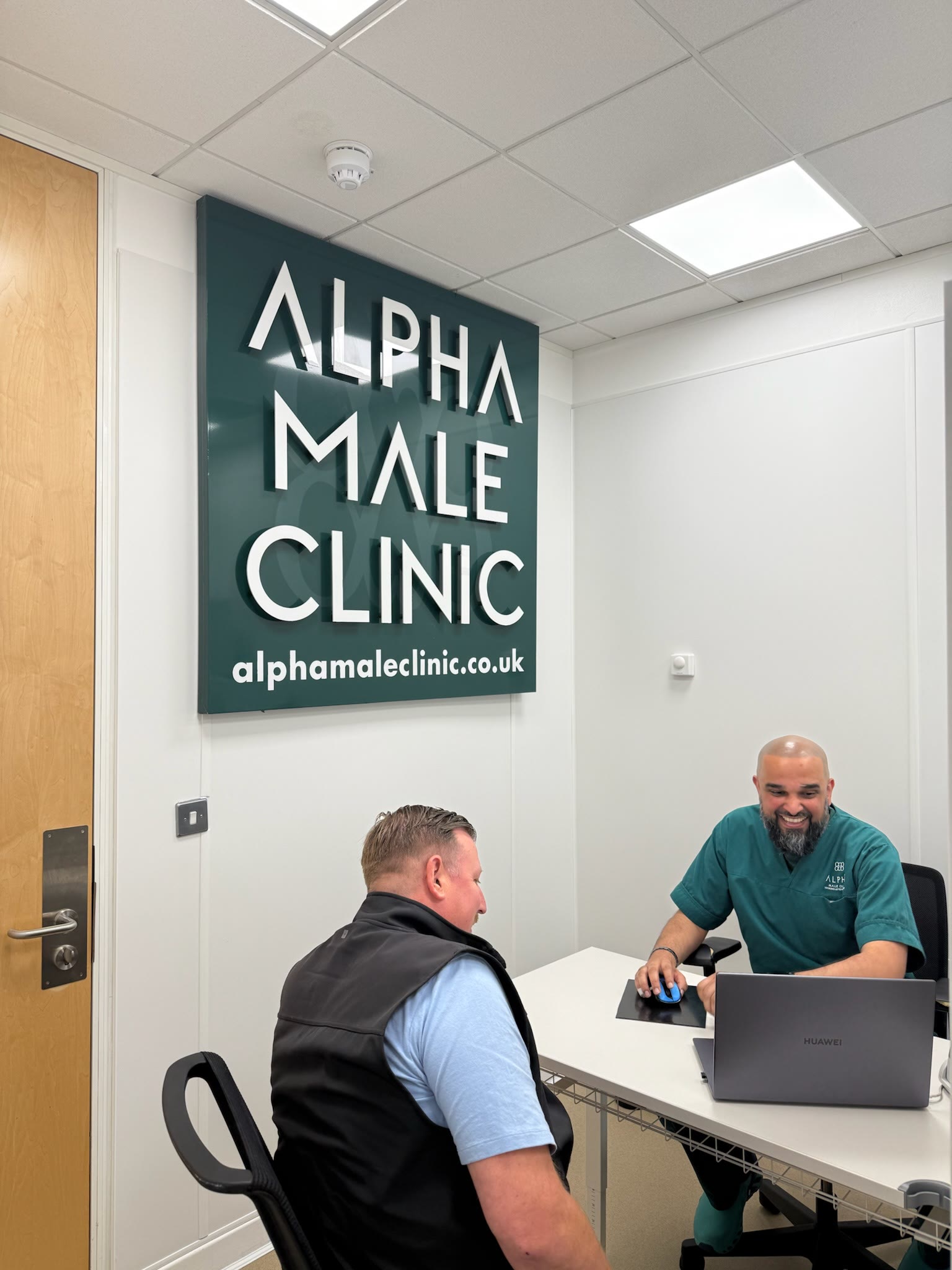
Dr Mustafa Ganijee
A UK GP with more than 14 years of medical experience. He examines you, agrees the plan with you and handles your follow-up, so the person who advised you is the person who treats you.
Questions men ask first
What is Peyronie's disease?
A build-up of fibrous scar tissue, called a plaque, in the wall of the penis. Because the scarred area does not stretch like healthy tissue, the penis bends towards it during an erection. It can also cause pain, shortening and an indented or hourglass shape.
What causes it?
In most cases it follows minor repeated injury during intercourse that the man does not notice at the time. Diabetes, some connective tissue conditions and a family history increase the risk. It is not caused by anything you did wrong.
How much curve is normal?
A slight natural curve is common and is not Peyronie's disease. What matters is a change: a new or increasing bend, a lump you can feel, pain, or difficulty with intercourse.
Will it get better on its own?
Pain often settles as the condition stabilises. The curvature itself resolves fully in only a small minority of men, and it can worsen during the active phase. That is why early assessment is advised.
How does PRP therapy help?
Platelet-rich plasma concentrates growth factors from your own blood at the site of the plaque. It is designed to support tissue repair and reduce symptoms. Outcomes vary and depend on how established the condition is.
How many sessions will I need?
A course is usual rather than a single injection. The number is agreed at consultation based on the plaque, your symptoms and how you respond to the first sessions.
How soon would I notice a change?
Typically over weeks to months rather than immediately. Pain tends to improve before curvature does. Curvature is measured at review so any change is recorded objectively.
Does the treatment hurt?
Local anaesthetic is used. Most men describe the injections as uncomfortable rather than painful, with tenderness for a day or two afterwards.
Can I still have sex during treatment?
You will be asked to avoid sex for a short period after each session, and the exact guidance is given at your appointment as part of aftercare.
What if the curvature is severe?
Where the deformity is severe or the plaque is heavily calcified, PRP therapy is unlikely to be enough on its own, and surgical assessment may be the more appropriate route. You will be told that plainly rather than sold a course of treatment.
What does it cost?
Pricing is confirmed at consultation, because it depends on how many sessions are appropriate. You receive the full cost in writing before anything is booked. A £100 deposit secures the appointment and is not refundable if you cancel less than 24 hours beforehand.
Will my own GP be told?
Not without your explicit consent. Nothing is shared with your GP or anyone else unless you agree to it.
Next step
Have the curvature assessed properly
Six questions, about sixty seconds, completely confidential. Outcomes are generally better when the condition is assessed early.
Take the self-assessment